


Healing Cross of Light
The Ripple Effect of the Cross
There are moments in an artist's life that quietly shape everything that follows.
For me, one of those moments came through a vision the Lord gave me many years ago. It eventually became a sculpture entitled Crux Gloria—Latin for Glorious Cross. I have also called it The Cross of Light, because that was the phrase the Lord impressed upon my heart as the vision unfolded.
In 1991, that vision became reality. The Ripple Effect of the Cross
There are moments in an artist's life that quietly shape everything that follows.
For me, one of those moments came through a vision the Lord gave me many years ago. It eventually became a sculpture entitled Crux Gloria—Latin for Glorious Cross. I have also called it The Cross of Light, because that was the phrase the Lord impressed upon my heart as the vision unfolded.
In 1991, that vision became reality.

Unlike many traditional depictions of the crucifixion, the sculpture does not present Christ's body hanging upon the Cross. Instead, His form has become an opening—a doorway illuminated from within. The empty silhouette reminds us that Christ's sacrifice is complete. The Cross is no longer merely a place of suffering; it has become the doorway through which we enter new life.
That single revelation has continued to ripple through my work for more than three decades.

One sculpture led naturally to another.
Beyond Forever explored the idea that the Cross not only reconciles us to God but also calls us toward one another. As we journey toward Christ, we discover that we are one family, united by His grace.
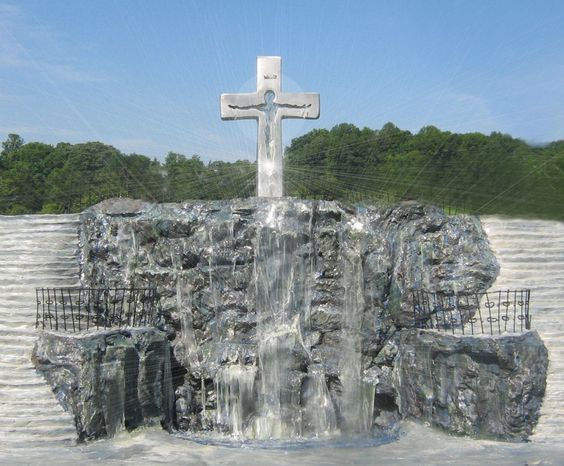
From there came The Healing Cross, where flowing water became a symbol of God's healing presence. Its polished stainless-steel surface reflects the viewer, gently reminding us that Christ's invitation is deeply personal. His sacrifice was made for each one of us.

That same stream of inspiration continued into The Pool of Bethesda, where living water flows through the Cross before cascading into a pool below. The imagery recalls the healing waters of Scripture while pointing to the continual invitation to renewal, restoration, and new life in Christ.
Another expression of this unfolding vision became Corpus Christi, a memorial sculpture installed at Kanuga Conference Center in Hendersonville, North Carolina. Illuminated each evening from within, it quietly proclaims the hope of the resurrection. Even as darkness falls, the light remains—a daily reminder that Christ has overcome death and opened the way back to the Father.
Looking back, I no longer see these sculptures as isolated works of art.

They are chapters of one continuing testimony.
Each piece explores another dimension of the same truth: the Cross is not simply an historical event. It is God's invitation into relationship, healing, reconciliation, and hope.
That is one of the reasons I wrote Song of Songs: A Divine Romance Between Art and Scripture.

Throughout the book, Scripture is paired with artwork, allowing visual imagery and God's Word to speak together. My hope is that readers will discover not simply the meaning behind the artwork, but the heart of the One who inspired it.
The verse that accompanies this reflection comes from Song of Songs 1:14 in The Passion Translation:
"As the fountain of the Lamb, I will hold Him and never let Him go."
That is my prayer as well.
That we would hold fast to Christ, discovering again and again that every work of grace begins—and continues—at the Cross.
If you haven't yet watched this latest episode of Reflections from the Studios, I invite you to take a few moments to do so. I hope it encourages you to see the Cross not only as the place where redemption was won, but also as the source from which God's transforming love continues to ripple outward into every part of our lives.
Grace and peace,
Tomas J. Fernandez Hope Through Arts
Comments